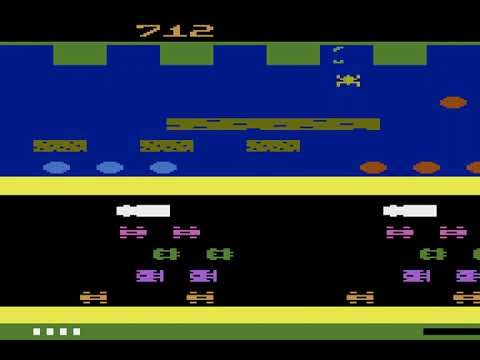

In the summer of 1982, Parker Brothers brought one of the arcade world's most beloved amphibians to home consoles with their Atari 2600 adaptation of Frogger. Originally developed by Konami for the arcade in 1981, this deceptively simple yet maddeningly addictive game challenged players to guide a hapless frog across busy highways and treacherous waterways. The home version, squeezed into a mere 4KB of ROM space, represented both the ingenuity and limitations of early 1980s home gaming technology.
Settling into your wood-paneled living room with the familiar weight of the Atari joystick in hand, Frogger immediately presents its core challenge with crystal clarity. The screen splits into two distinct danger zones: the bottom half features multiple lanes of speeding traffic, while the top half presents a river filled with floating logs, turtles, and deadly alligators. Your mission couldn't be simpler in concept—get the frog from bottom to top—yet the execution demands split-second timing and nerves of steel.
Gameplay Mechanics and Controls
The beauty of Frogger lies in its elegant simplicity. Using only the joystick's four directional inputs, players hop their amphibious avatar one space at a time across the grid-based playfield. There's no fire button, no complex combinations—just pure directional movement that feels immediately intuitive yet requires genuine skill to master.
The highway section demands careful observation of traffic patterns. Cars, trucks, and motorcycles speed across the screen at varying velocities, creating gaps that open and close with mathematical precision. Success requires learning these patterns while maintaining the confidence to commit to risky jumps when safe opportunities arise. The frog can only move forward, backward, left, or right—never diagonally—which adds a chess-like strategic element to navigation.
The river section introduces an entirely different challenge. Here, standing still means death, as the frog must continuously hop onto moving platforms—logs, turtles, and lily pads—to avoid drowning. Some turtles dive underwater periodically, adding another layer of timing-based complexity. The final challenge involves landing on one of five lily pads at the screen's top, but even these safe havens present dangers, as alligators occasionally occupy them with snapping jaws extended.
Each successful crossing increases the difficulty incrementally. Traffic moves faster, safe platforms become scarcer, and the timer—represented by a steadily decreasing bonus score—applies constant pressure. This progressive difficulty curve keeps players engaged far beyond the initial novelty, as each new level presents familiar challenges with heightened intensity.
Graphics and Visual Presentation
Working within the Atari 2600's notorious hardware constraints, Parker Brothers achieved a remarkably faithful adaptation of the arcade original. The frog sprite, while simple, clearly reads as amphibious with its distinctive green coloring and basic shape. The various vehicles maintain their arcade counterparts' essential characteristics—the pink cars, yellow taxis, and purple trucks all translate recognizably to the home system.
The river section showcases particularly clever sprite work. The brown logs roll convincingly across the screen, while the turtle sprites alternate between surface and submerged states with clear visual distinction. The lily pads at the top provide satisfying visual feedback when occupied, changing color to indicate successful completion.
However, the 2600's limitations become apparent in the reduced number of simultaneous moving objects compared to the arcade version. Traffic density feels somewhat sparse, and the river contains fewer floating platforms. The screen also lacks the arcade's detailed background elements, presenting instead a stark black backdrop that, while functional, sacrifices some of the original's visual charm.
Sound Design
The 2600's primitive sound capabilities receive a workout in Frogger, with mixed results. The distinctive hopping sound effect—a brief electronic chirp—accompanies every movement and quickly becomes as recognizable as the game itself. Vehicle sounds provide audio cues for approaching danger, with different pitches representing various traffic types.
The drowning sound effect delivers appropriately tragic finality when the frog meets its watery demise, while successful lily pad landings trigger satisfying completion tones. However, the absence of the arcade's memorable musical themes represents a significant loss. The 2600 version relies primarily on sound effects rather than music, creating a somewhat sterile audio environment compared to its coin-operated inspiration.
Difficulty and Replay Value
Frogger exemplifies the "easy to learn, impossible to master" philosophy that defined many classic arcade games. Initial attempts might see players struggling to cross even the first road, but the learning curve feels perfectly calibrated. Each death teaches valuable lessons about timing and pattern recognition, encouraging immediate retry attempts.
The game's scoring system adds significant replay value beyond simple completion. Bonus points reward quick completion times, successful lily pad landings, and escorting lady frogs to safety—a feature that adds variety to later levels. High score chasing becomes genuinely compelling as players discover optimal routes and timing strategies.
The progressive difficulty ensures that even experienced players face genuine challenges. By level five or six, the screen becomes a chaotic ballet of high-speed obstacles that demands absolute precision. This scaling difficulty, combined with the game's inherent randomness, creates virtually unlimited replay value.
Historical Significance and Legacy
Parker Brothers' Frogger arrived during a crucial period in home gaming history, when third-party publishers were establishing themselves as serious competitors to Atari's first-party offerings. The game demonstrated that arcade-perfect translations, while impossible on 2600 hardware, could still capture the essential gameplay elements that made originals compelling.
This adaptation also represented early success in video game licensing, proving that popular arcade properties could find profitable second lives on home consoles. The game's commercial success helped establish Parker Brothers as a major player in the video game industry and paved the way for future arcade-to-home translations.
Comparison to Other 2600 Action Games
Within the 2600's action game library, Frogger occupies a unique niche. Unlike shoot-em-ups such as Space Invaders or Asteroids, it emphasizes movement and timing over reflexive firing. The game shares DNA with other "avoid and survive" titles like Freeway, but offers significantly more complex gameplay mechanics and visual variety.
Compared to other Parker Brothers releases like Q*bert, Frogger feels more immediately accessible while maintaining comparable depth. Its grid-based movement system proved influential for later 2600 action games, demonstrating how simple control schemes could support sophisticated gameplay challenges.
Frogger for the Atari 2600 stands as a testament to creative adaptation under technical constraints. While it couldn't match the arcade original's audiovisual splendor, it successfully translated the core gameplay experience that made the original irresistible. For players willing to embrace its limitations, the game offers timeless entertainment that remains engaging decades after its release.

