Adventure Test
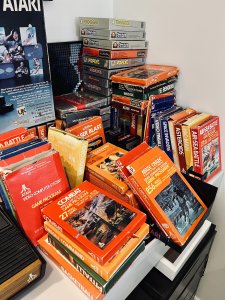
A Pixelated Quest Begins
In 1979, when most Atari 2600 games consisted of simple arcade-style challenges, Warren Robinett dared to dream bigger. "Adventure" emerged as a groundbreaking title that would forever change what players expected from home console gaming. This wasn't just another game of Pong or Combat—it was an entire world waiting to be explored, complete with castles, dragons, and treasures hidden in the flickering glow of your family's wood-paneled television set.
Adventure holds the distinction of being the first action-adventure game on a home console, predating The Legend of Zelda by seven years. What Robinett accomplished with just 4 kilobytes of memory seems miraculous by today's standards, creating an interconnected world of 30 rooms that felt vast and mysterious to players accustomed to single-screen experiences.
The Quest for the Enchanted Chalice
Your mission in Adventure is deceptively simple: retrieve the Enchanted Chalice and return it to the Golden Castle. You control a small square avatar—affectionately known as a "freaky little guy" among fans—navigating through a kingdom filled with perilous creatures and hidden secrets. The game world consists of three difficulty levels, each expanding the complexity and size of your quest.
The first level serves as a gentle introduction, featuring a single dragon and a straightforward path to victory. However, levels two and three transform Adventure into a genuinely challenging experience. These advanced modes scatter keys, swords, and magical items across multiple screens, forcing players to methodically explore every corner of the kingdom. The randomization of item placement in level three ensures that no two playthroughs follow identical patterns, a revolutionary concept for 1979.
Movement feels deliberately weighty—your square hero doesn't zip around the screen but moves with purpose through maze-like corridors and open chambers. This pacing, which might feel sluggish to modern players, actually enhances the game's sense of exploration and discovery. Each new screen transition carries the potential for wonder or terror.
Dragons, Mazes, and Magical Artifacts
Adventure's bestiary includes three distinct dragons, each with unique behavioral patterns that players must learn and exploit. Rhindle, the red dragon, guards the White Castle with fierce determination, while Grundle, the green dragon, patrols the Black Castle's treacherous corridors. Most fearsome is Yorgle, the yellow dragon, whose unpredictable movements and tendency to swallow essential items can derail even the most carefully planned expedition.
Combat mechanics are refreshingly straightforward—touch a dragon with your sword, and it dies instantly. However, acquiring and maintaining possession of the sword becomes the real challenge. Dragons can swallow both you and your weapons, creating tense moments where you must carefully position yourself for the killing blow while avoiding their deadly touch.
The game's inventory system, primitive by today's standards, allows you to carry only one item at a time. This limitation creates meaningful strategic decisions: Do you drop the key to pick up the sword when facing a dragon? Should you risk leaving the bridge unguarded while fetching the magnet? These choices give Adventure a puzzle-like quality that elevates it above simple action fare.
Magical items add layers of complexity to your quest. The bridge allows passage over walls, the magnet attracts distant objects, and the mysterious bat—initially a bug that Robinett transformed into a feature—randomly redistributes items throughout the kingdom. This unpredictable element keeps even experienced players on their toes.
The First Easter Egg
Perhaps Adventure's most lasting contribution to gaming culture lies hidden within its code: the first video game Easter egg. Robinett, frustrated by Atari's policy of not crediting developers, secretly embedded his signature within the game. By performing a specific sequence of actions involving the gray dot and the Black Castle, players can access a hidden room displaying "Created by Warren Robinett" in colorful letters.
This rebellious act of digital graffiti established a tradition that continues today. The Easter egg's discovery sparked a company-wide search at Atari for similar hidden messages, coining the term "Easter egg" for concealed content. It represents a moment when individual creativity triumphed over corporate anonymity, making Adventure a symbol of developer expression.
Technical Wizardry Within Constraints
Robinett's programming achievements in Adventure cannot be overstated. Working within the Atari 2600's severe limitations—128 bytes of RAM and a 6507 processor running at 1.19 MHz—he created what felt like a living, breathing world. The game's graphics, while abstract by necessity, possess a charming minimalism that sparks imagination rather than stifling it.
The castle designs, rendered as simple geometric shapes, somehow convey distinct personalities. The Yellow Castle's open architecture suggests accessibility, while the Black Castle's labyrinthine corridors promise danger and confusion. Even the dragons, despite being composed of just a few pixels, display recognizable characteristics through their movement patterns and colors.
Room transitions create a sense of spatial continuity rarely seen in earlier games. Moving off one screen's edge smoothly transports you to the corresponding location on another screen, building a mental map that players could navigate even decades later. This interconnectedness transforms Adventure from a series of discrete challenges into a cohesive world.
Legacy and Modern Relevance
Adventure's influence on game design extends far beyond its technical innovations. It established the template for action-adventure games that developers still follow today: exploration, item collection, puzzle-solving, and combat woven into a coherent narrative experience. Every Zelda game, every Metroidvania title, every modern adventure game owes a debt to Robinett's pioneering work.
For modern players, Adventure offers both historical significance and genuine entertainment value. Yes, the graphics are primitive, and the controls feel different from contemporary games. However, beneath these surface elements lies a perfectly crafted game loop that remains engaging today. The sense of discovery when finding a new room or solving a puzzle transcends graphical limitations.
The game's brevity—completable in 15-30 minutes once you know the solutions—actually works in its favor for modern audiences. Adventure respects your time while delivering a complete, satisfying experience. It's perfect for quick gaming sessions or introducing younger players to gaming history.
Adventure deserves recognition not just as a historical curiosity but as a genuinely entertaining game that holds up remarkably well. Its influence on the medium makes it essential playing for anyone interested in understanding how video games evolved from simple diversions into complex interactive experiences. In those flickering pixels and simple sounds lies the DNA of modern gaming itself.